Investment Thesis
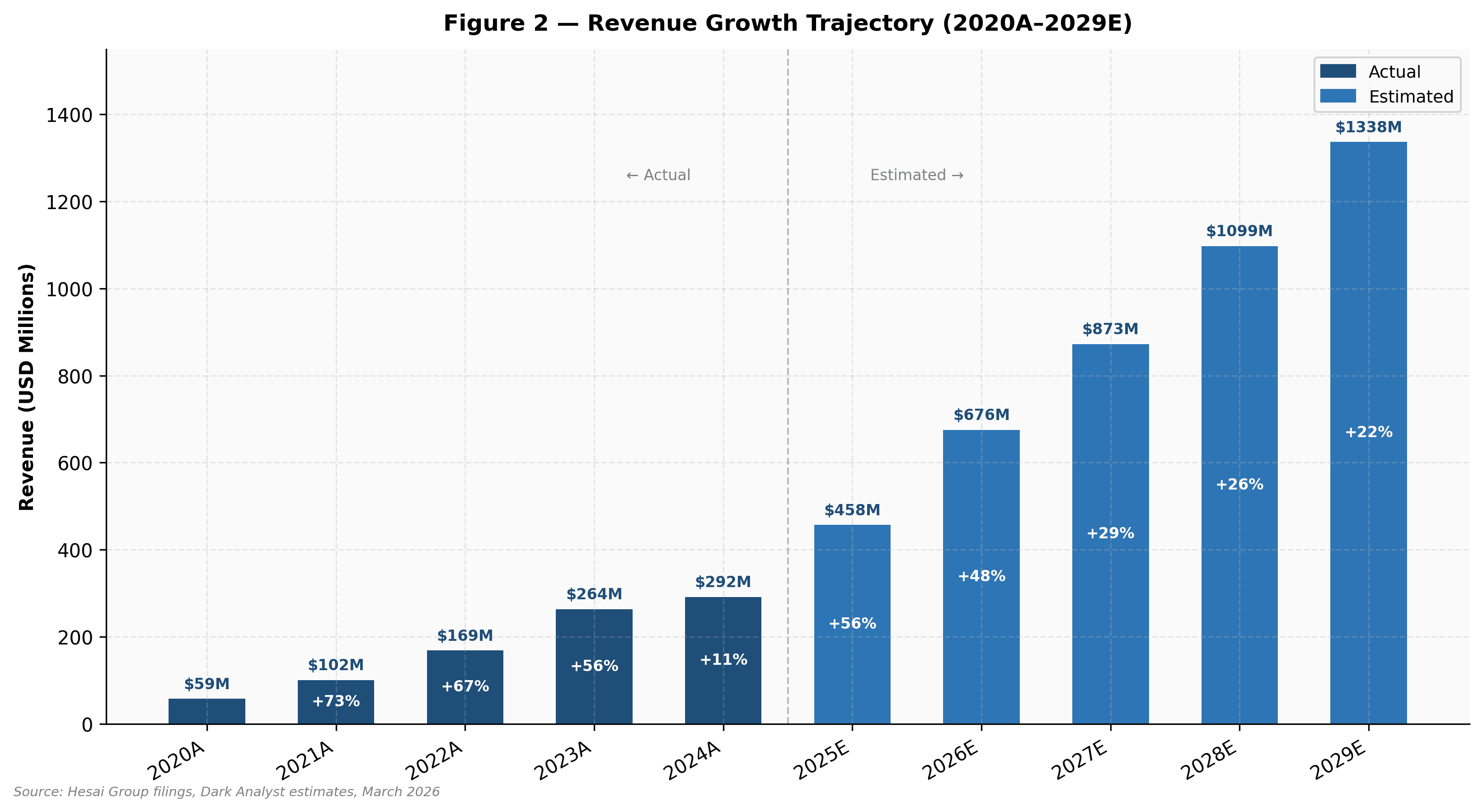
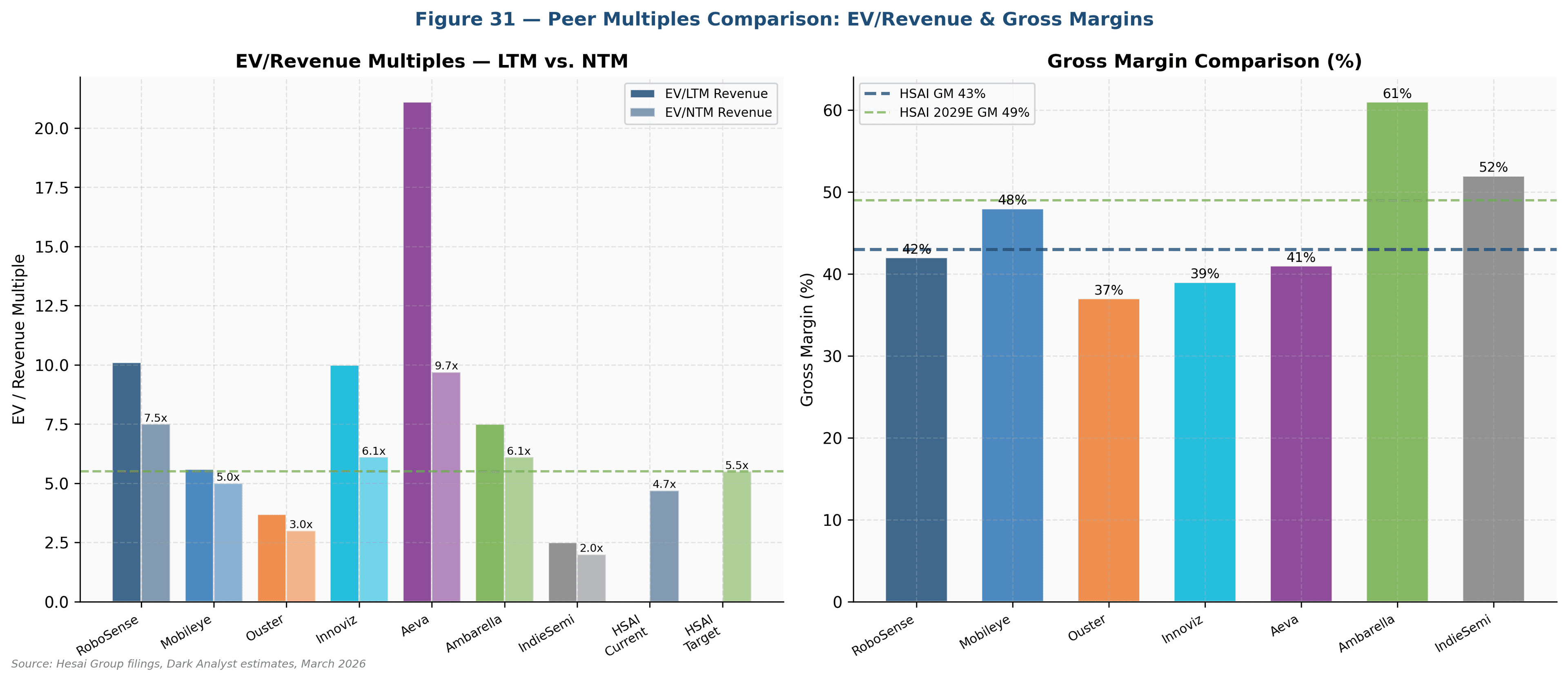
Hesai Group (HKEX: 2525; NASDAQ: HSAI) is the global LiDAR market leader by volume and the only pure-play LiDAR company to achieve full-year GAAP profitability. The stock trades at approximately 4x my 2026E forward revenue estimate of $676M — a 27% discount to the peer group median of 5.5x NTM revenue.
The discount is largely explained by a single tail risk: a potential BIS Entity List designation that would restrict access to US-origin semiconductor technology. I assign 10–15% probability to this outcome over a 12-month horizon. Adjusted for that risk, the residual discount is difficult to justify given Hesai's competitive position, growth rate, and balance sheet ($358M net cash).
Why Now
Three developments have sharpened the entry case over the past 75 days:
- GAAP Profitability Confirmed: Hesai guided FY2025 GAAP net income of RMB 350–450M ($49–63M), a milestone no other LiDAR company has reached.
- Embodied AI Ramp: Robotics LiDAR shipments grew 1,312% YoY in Q3 2025. Full-year 2025 robotics units exceeded 200,000 — establishing a structurally distinct second revenue stream.
- 15th Five-Year Plan: China's 15FYP, being formally approved this month, designates intelligent connected vehicles as a strategic priority. National L3/L4 safety standards become mandatory by July 2027, pulling forward ADAS attach rate expansion.
Business Overview
Hesai designs, manufactures, and packages LiDAR sensors entirely in-house — proprietary ASIC chip design, MEMS sensor architectures, and owned production lines. This vertical integration is the structural foundation of the cost advantage. Competitors must outsource chip design or foundry, paying margins that Hesai internalises. At 1.6 million units shipped in 2025, Hesai produces at roughly 2x the volume of its nearest peer.
Revenue for FY2025 is guided at RMB 3.0–3.5 billion (~$458M at midpoint), representing approximately 47% YoY growth. The company holds 2,071 patents.
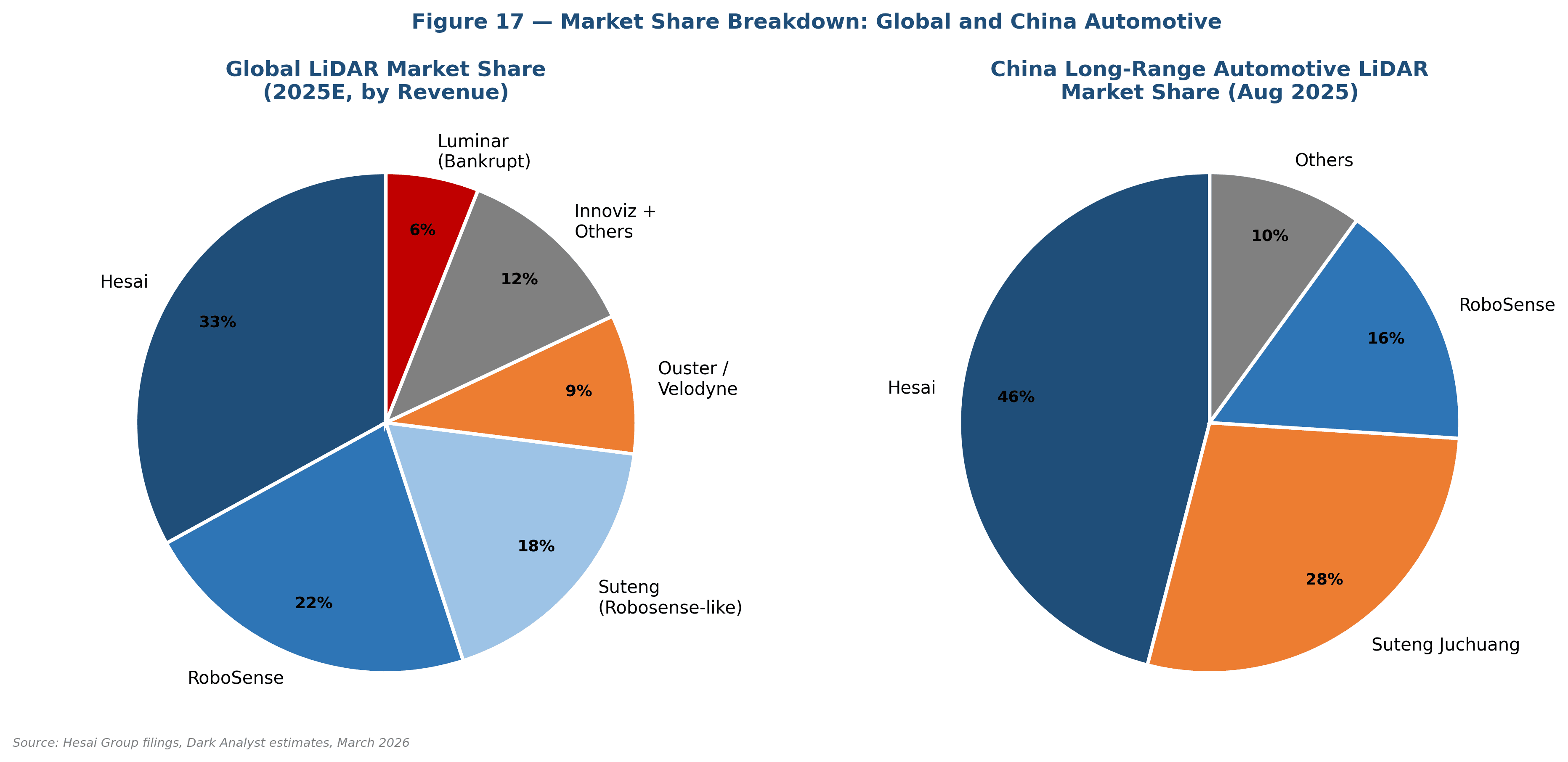
The competitive field has consolidated significantly. Luminar filed for Chapter 11 in December 2025. Innoviz, Aeva, and Ouster remain subscale. Two credible players dominate: Hesai at 33% global revenue share and 46% of China long-range automotive, and RoboSense (NASDAQ: RR) at 21% global share.
The key competitive development: on March 5, BYD announced 11 new energy vehicles using RoboSense's EM4 as the exclusive LiDAR partner across its main brand, Denza, Yangwang, and Fang Cheng Bao — with reports indicating commitment to up to 32 models. This sharpens the duopoly dynamic and is a headwind worth monitoring. Hesai continues to supply BYD on other lines and retains design wins across 24 OEMs and 120+ vehicle models, including Li Auto, XPeng, Nio, Changan, SAIC, Xiaomi, and JV partnerships with Audi, GM, and Volkswagen.
Financial Analysis
Driver 1: ADAS Penetration Inflection
LiDAR attach rates on Chinese L2+/L3 vehicles currently sit around 12%. The path to 20–25% by end-2026 runs through three structural catalysts: the 15FYP's ICV mandate, mandatory L3/L4 safety standards by July 2027, and L3 pilot commercialisation already underway following road approvals in December 2025.
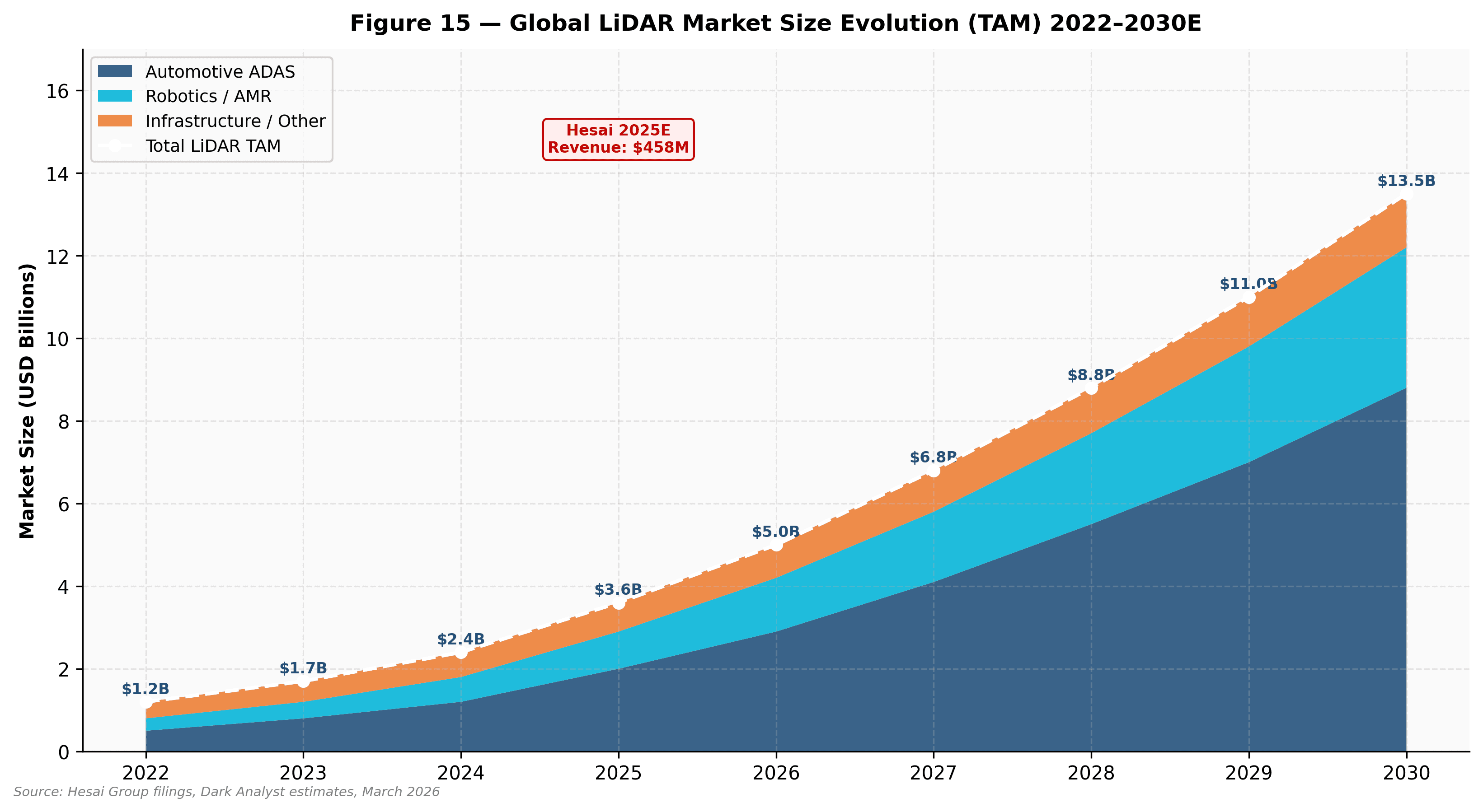
China produces approximately 25 million vehicles annually. At a 20% attach rate, that implies 5 million+ addressable LiDAR units per year — more than 3x Hesai's 2025 shipment base. The global automotive LiDAR market is projected to grow from ~$1.2B (2024) to $9.6B by 2030, a 42% CAGR. Hesai's CES 2026 announcement to double production capacity from 2 million to 4 million+ units reflects management confidence in the demand pipeline.
Driver 2: Embodied AI
Hesai's robotics LiDAR segment grew 1,312% YoY in Q3 2025 — from 4,295 to 60,639 units in a single quarter. Full-year 2025 robotics shipments exceeded 200,000 units. The embodied AI market — humanoid robots (UBTECH, Unitree), warehouse AMRs (JD.com, Meituan), and autonomous delivery — is projected at $4–6B globally in 2026, with LiDAR emerging as the reference spatial perception sensor.
The economics are differentiated: robotics ASPs run $200–$500 per unit versus ~$175 blended for automotive ADAS, at higher margins. Hesai's JT series, purpose-built for robotics and launched in December 2024, shipped over 20,000 units in its first month. I model robotics contributing 25%+ of revenue by 2027E. If humanoid production timelines accelerate, this segment could justify a standalone multiple re-rating.
Valuation
Per-share figures in this memo are split-adjusted for Hesai's 8-for-1 share subdivision, effective 10 July 2026. As originally published in March 2026, the price target was HK$231 against a reference price of HK$184.90, and the diluted share count was 138M.
EV/NTM Revenue is the appropriate primary framework here. Near-term FCFs are negative (turning positive in 2027E), and over 80% of any DCF value sits in terminal value — making intrinsic approaches unreliable at this stage.
The peer group — RoboSense, Mobileye, Ambarella, Ouster, Innoviz, Aeva, Indie Semiconductor — trades at a median of approximately 5.5x NTM revenue. 2525.HK at ~HK$23.11 trades at roughly 4x my 2026E revenue estimate of $676M. Closing to the peer median simply reflects a market pricing confirmed leadership rather than execution uncertainty.
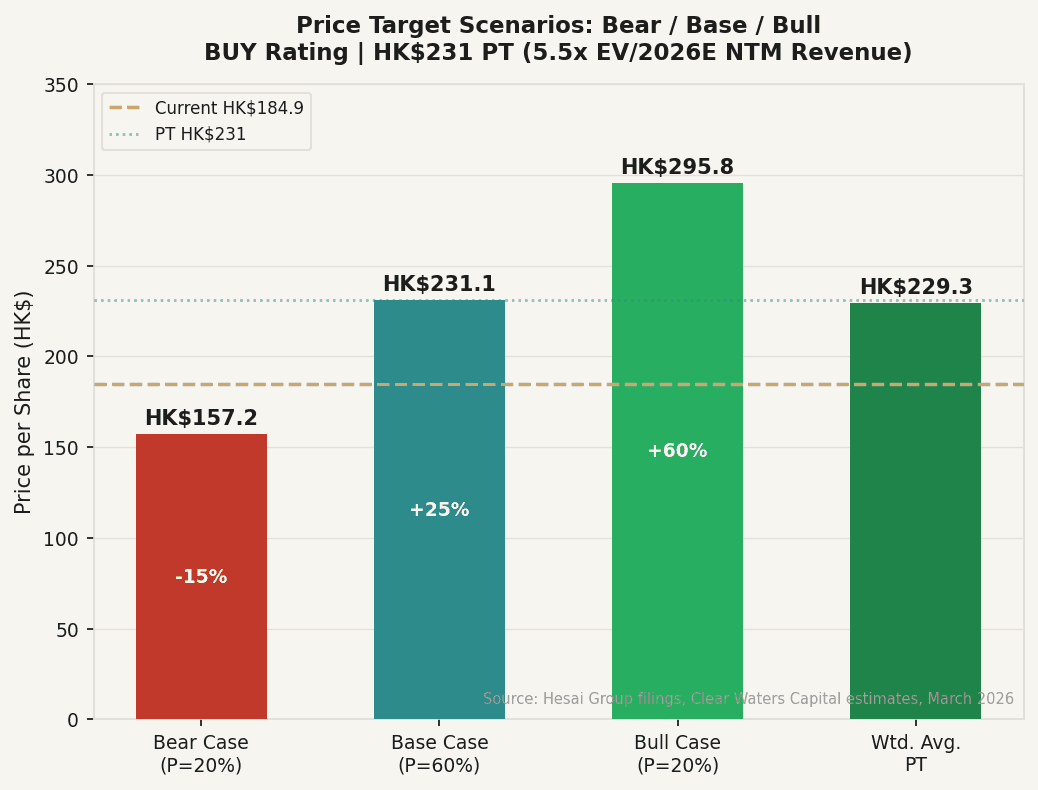
At 5.5x applied to $676M, enterprise value is ~$3.7B. Adding $358M net cash and dividing by ~1,104M diluted shares (138M pre-split × 8) yields approximately HK$28.89 per share — ~25% upside from current levels.
Base case: HK$28.89 — ADAS attach rate reaches 18% by year-end, robotics sustains 200K+ quarterly run rate, BIS risk remains unresolved.
Bull case: HK$36.98 — ADAS accelerates to 22%+ attach rate, robotics inflects further, international OEM win removes multiple discount, or BIS risk clears formally.
Bear case: HK$19.65 — BIS designation does not occur but robotics timeline slips 12–18 months, pushing the second revenue engine to 2028–2029.
Risks
The primary risk is a BIS Entity List designation. This would restrict Hesai's access to US-origin semiconductor technology and EDA tools, with potential secondary consequences for ADS holders. Estimated impact on designation: 40–60% share price drawdown. I assign 10–15% probability over 12 months.
The Pentagon added Hesai to its 1260H list in January 2024 and removed it in August 2024 after determining the company did not meet the criteria. Hesai's products serve civilian applications — passenger vehicle ADAS and delivery robots — with no known military contracts. The BIS operates under a different legal standard, so the 1260H reversal provides precedent but not a guarantee.
Secondary risks:
- Robotics timing. A 12–18 month delay in humanoid robot production timelines would push robotics revenue contribution from 2027 to 2029, keeping the stock priced as a pure automotive hardware business.
- ASP deflation. Hesai must grow units 2–3x faster than prices decline. If RoboSense or state-subsidised Tier-2 competitors drive ASP erosion beyond 25% annually, operating leverage stalls.
- BYD-RoboSense concentration. The pace at which BYD converts to RoboSense across its 32-model pipeline, and any corresponding ASP pressure in the Chinese OEM segment, warrants close monitoring.
Conclusion
The thesis rests on a straightforward gap: the world's most profitable LiDAR company, growing at 45%+ annually with 120+ model design wins and a 1,312% YoY robotics ramp, trades at a meaningful discount to unprofitable peers. The BIS tail risk is real and priced in. What is not fully priced in is the systematic nature of China's ADAS mandate and the early evidence of robotics becoming a structurally distinct revenue stream.
What to watch:
- FY2025 earnings (March 2026): GAAP profitability confirmation and 2026 revenue guidance at or above RMB 4.8B ($676M).
- Robotics shipment trajectory: Sustained quarterly volumes above 200K units would validate the second growth engine thesis.
- International OEM wins: A European or North American design-win announcement would catalyse a multiple re-rating.
- BIS policy signals: Any formal resolution reducing Entity List risk removes the primary valuation overhang.
- BYD-RoboSense volume ramp: The pace of conversion and its impact on Hesai's China ADAS market share in H2 2026.
Initiating coverage: Buy. 12-month price target: HK$28.89 (split-adjusted; HK$231 pre-split). Conviction: Medium.