Investment Thesis
Tongfu Microelectronics (SZSE: 002156) is transitioning into AI packaging. The market is pricing that transition as complete. It is not.
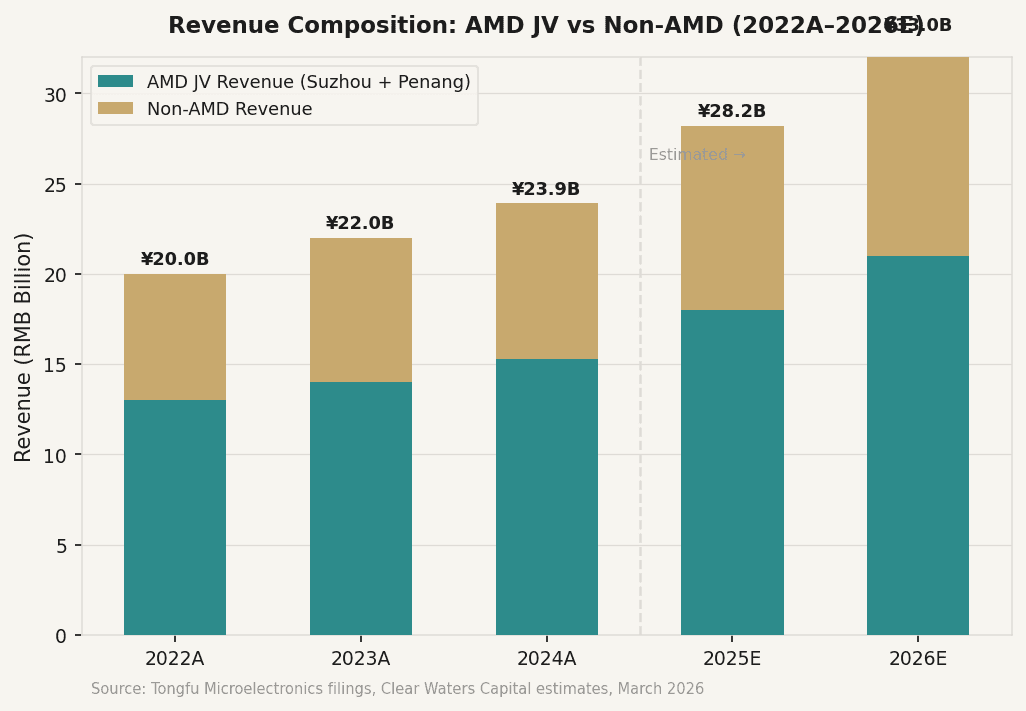
TFME's primary revenue engine today is EPYC server CPU packaging — two AMD joint ventures (TF-AMD Suzhou and TF-AMD Penang) that generated ¥15.3B in FY2024, or 64% of consolidated revenue. The AI packaging thesis rests on a separate strand: TFME's 2.5D technology has passed Huawei Ascend 910B customer qualification and it is co-developing CoWoS-like integration with AMD for next-generation AI products. That long-horizon thesis is legitimate. At 19.2x EV/EBITDA and 75x trailing P/E against a decade median ROIC of 3.99%, the multiple is not.
We rate TFME HOLD with a ¥47.00 12-month price target — approximately 4% below current. The upgrade trigger is unambiguous: confirmed volume 2.5D customer qualification or AMD's confirmation of TFME as a primary packaging partner for MI400-class AI GPUs before end of 2026.
Why Now
On February 14, 2026, the Shenzhen Stock Exchange accepted TFME's ¥4.4B private placement. Reading the prospectus makes the timeline legible. All four production projects fund expansion of existing-generation technologies: flip-chip, wire-bond, wafer-level packaging, and SiP. Chinese financial media (Jieface News) noted the projects involve no new technology development — only capacity expansion of existing processes. These assets ramp in 2028–2029. Separately, 28% of the raise (¥1.23B) is allocated to working capital and debt repayment — near the regulatory ceiling — signalling that part of this equity issuance is shoring up a stretched balance sheet, not purely funding growth. And the placement adds up to 455.3 million new shares: approximately 30% dilution, confirmed and near-term.
TFME's stock ran from a 52-week low of ¥21.50 to a peak of ¥59.20 — over 175% — before retreating to ¥49.08. The recalibration is underway; we think it has further to go.
Business Overview
Tongfu Microelectronics is an OSAT (outsourced semiconductor assembly and test) company headquartered in Nantong, Jiangsu. Its competitive position rests on two AMD joint ventures formed in 2016–2017: TF-AMD Suzhou and TF-AMD Penang, in which AMD holds 15% equity stakes in each entity. These JVs run ultra-large format FCBGA lines — 115mm×115mm substrate, required for AMD's Zen 5 EPYC server CPUs — at 98% yield rates. EPYC packaging qualification takes 12–18 months; AMD cannot redirect this volume casually. The bilateral equity cross-ownership makes the structural lock-in genuine.
AMD's four-year OpenAI supply agreement for up to 6GW of chip deployment extends demand visibility through the decade. TFME's AI packaging role is not zero: it handles outer FCBGA assembly and testing steps for AMD's MI-series accelerators — the primary 3D SoIC stacking and CoWoS integration is performed by TSMC — and this work is in engineering assessment for volume qualification in the MI300 and MI350 supply chain. This is not revenue today. It is the proving ground for the advanced packaging transition.
Financial Analysis
Driver 1: The EPYC Engine
The AMD JVs generated combined revenue of ¥15.3B in FY2024 (Suzhou ¥7.7B, Penang ¥7.6B). The Zen 5 Turin EPYC ramp drove Suzhou revenue up 99% YoY in H1 2025; AMD-specific volumes rose to approximately 64% of consolidated H1 2025 revenue. Full-year 2025 revenue is tracking approximately 18% growth, with trailing 12-month revenue eclipsing $3.73B by Q3 2025.
Driver 2: Domestic Substitution
Non-AMD revenue reached ¥8.6B in FY2024, growing across verticals: automotive packaging +200% YoY, MediaTek mobile SoC +46%, RF products +70%, memory +40%. Chairman Shi Mingda targets 40% non-AMD revenue within three years. TFME's 2.5D technology is verified by Huawei Ascend 910B, with domestic AI chip packaging orders growing 53% in 2024 as US restrictions drove Chinese designers to source locally.
The honest framing: domestic substitution is a mid-tier story today — FCBGA for domestic AI chips, not CoWoS-class volume. A credible ¥3–5B incremental revenue opportunity over 3–5 years. It de-risks AMD concentration over a three-year horizon but does not independently justify the current premium multiple.
What the Market Is Underweighting
Seven of TFME's top ten shareholders reduced positions in Q3 2025, per SZSE quarterly holder registry filings. More significantly, Huada Group — the founding controlling shareholder — completed its planned 1% stake sale (~15 million shares) by January 26, 2026, per SZSE filing. Big Fund I has divested from a peak 21.7% stake to approximately 6.7%, with a further 2.5% reduction plan filed in May 2025.
The sovereign backstop narrative holds that Big Fund III (¥344B, launched May 2024) provides ambient support. That may be true at the sector level. No confirmed direct Big Fund III equity investment in TFME has been announced. The shareholders with the most precise information about the transition timeline — the founding family and the primary state fund — have both acted on full valuations.
Valuation
We use a blended methodology: 55% DCF and 45% EV/EBITDA comps. The structural context for the DCF: TFME's historical median ROIC is 3.99% over the past decade — approximately 3.78% on a Q3 2025 YTD basis — roughly one-third of the 12.0% WACC applied. The OSAT industry structurally earns below its cost of capital. Premium multiples demand proof of execution.
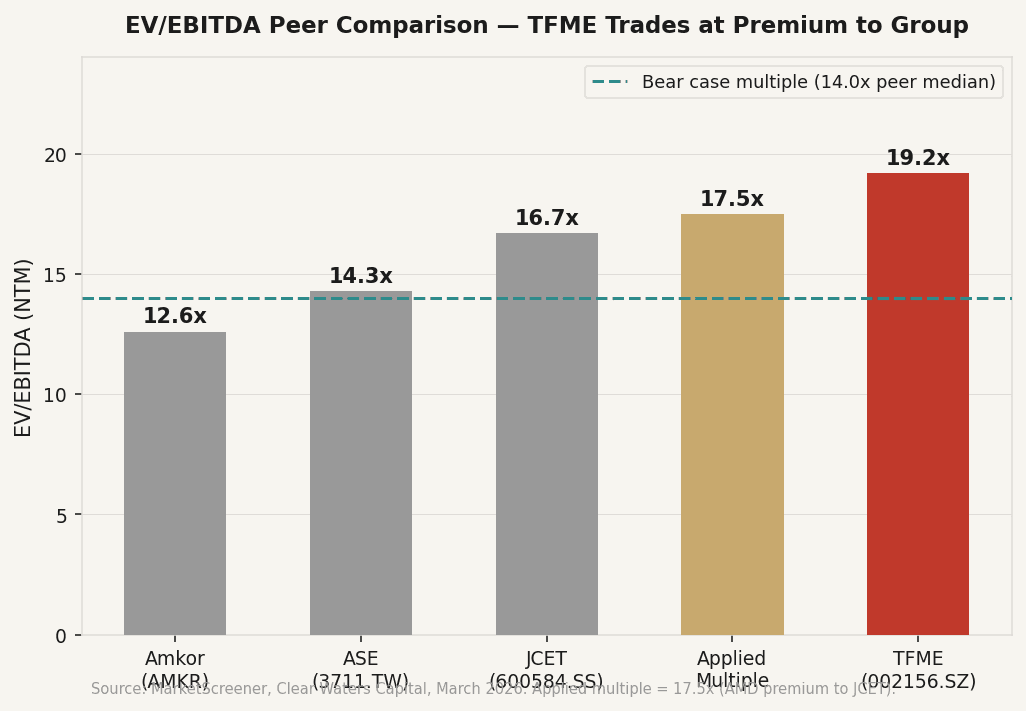
| Method | Key Input | Implied Price | Weight | |--------|-----------|---------------|--------| | DCF | 12.0% WACC, 2.5% TGR | ¥47.90 | 55% | | EV/EBITDA Comps | 17.5x (AMD premium to JCET 16.7x) | ¥44.65 | 45% | | Blended | | ¥47.00 | 100% |
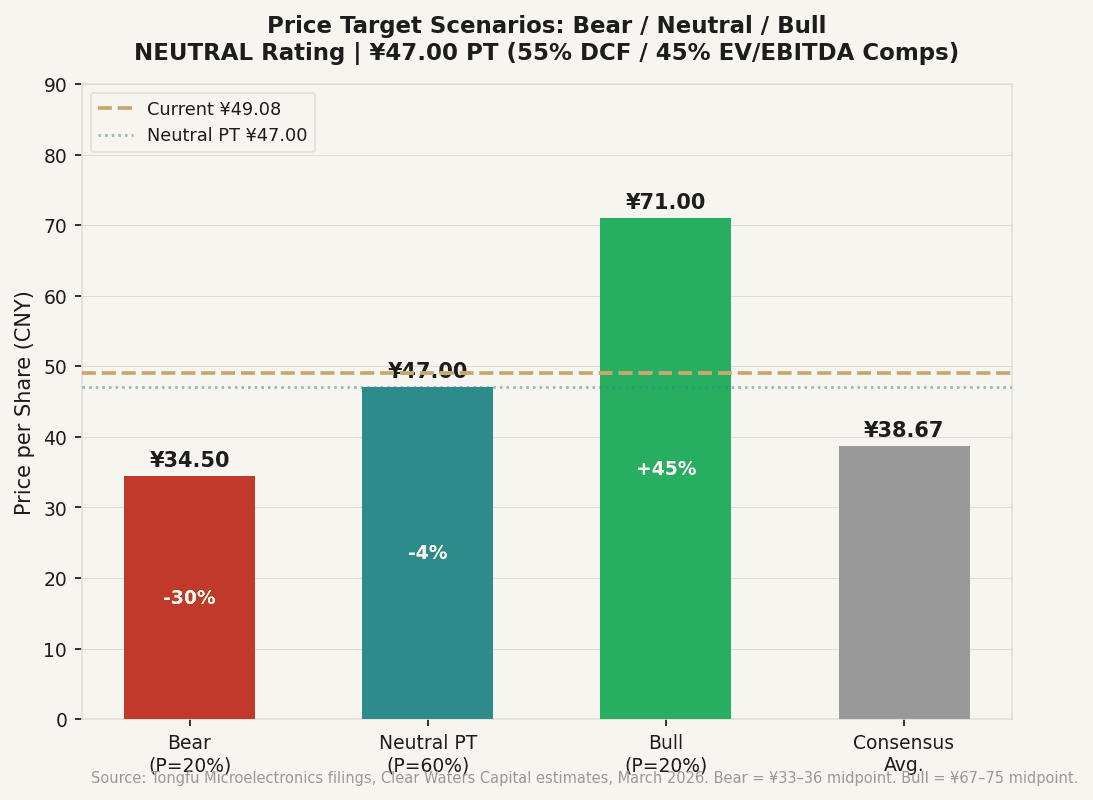
At 19.2x EV/EBITDA, TFME trades at a meaningful premium to every global OSAT peer. We apply 17.5x — a modest premium to JCET reflecting AMD's bilateral cross-equity ownership and structural switching costs — not the current 19.2x, which demands confirmed AI execution. Sell-side consensus average 12-month price target is ¥38.67 (range ¥35.40–¥55.00) — 21% below current, corroborating that ¥47 is not an attractive entry.
Bear case: ¥33–36 — AMD loses material server CPU share to Intel Granite Rapids, or BIS Affiliates Rule resumes without Penang exemption. At peer median 14x EV/EBITDA: 31–33% downside from current.
Base case: ¥47.00 — CPU franchise holds, domestic substitution continues at mid-tier, 2.5D commissioning slips to H2 2026 or 2027.
Bull case: ¥67–75 — AMD confirms TFME as primary MI400 packaging partner at volume, advanced packaging mix crosses 45%, multiple re-rates to 22x+.
Risks
Primary risk: AMD server CPU share loss. Intel Granite Rapids targeting x86 server market share is the proximate threat. A 5 percentage point AMD server share loss produces an 8–12% TFME revenue decline in its largest segment. At 75x trailing P/E, the amplification is severe: revenue decline → operating leverage hit at 14.6% gross margins → ¥19B interest-bearing debt service becomes harder → multiple compression. Bear case at peer median 14x EV/EBITDA: ¥33–36, or 31–33% downside.
BIS Affiliates Rule (Penang tail risk). The BIS Affiliates Rule, paused November 10, 2025 through November 10, 2026, requires OSAT facilities outside China to pass a beneficial ownership test: if combined Chinese-entity ownership exceeds 25%, the facility cannot handle US-export-controlled chips without a license. AMD holds 15% of TF-AMD Penang; the full Chinese-entity ownership chain requires disclosure verification. Non-renewal or a narrowed JV carveout after November 2026 creates immediate regulatory uncertainty for ¥7.6B in annual Penang revenue.
Balance sheet and dilution. TFME's asset-liability ratio stands at 63% as of Q3 2025 — an all-time high. The ¥4.4B private placement adds up to 455.3 million new shares (~30% dilution), with 28% of proceeds allocated to working capital and debt repayment. The equity raise is partly defensive, not purely offensive.
Earnings quality. Q1–Q3 2025 deducted non-recurring net profit (扣非净利润) was ¥778M versus ¥860M headline — an underlying growth rate of +10.7% against +32.2% on the headline. At 75x trailing P/E, the gap between headline and core earnings is material. FY2025E guidance of ¥1.1–1.35B should be read against this deducted-basis track record. Management acknowledged in their January 2026 investor Q&A that HBM packaging "remains dominated by international memory IDMs" — the company itself flagging the near-term gap.
Conclusion
The EPYC CPU franchise is real, structurally locked-in, and compounding. The AI packaging pathway — through the AMD co-development agreement and Huawei Ascend 910B qualification — is not fabricated. The thesis breaks to the upside if the Nantong 2.5D line achieves volume qualification and AMD publicly confirms TFME as a primary MI400 packaging partner.
That event has not occurred. The February 2026 prospectus confirms the current capital allocation is expanding existing-generation capacity, not funding the AI packaging transition. Investors paying a 19.2x EV/EBITDA multiple should wait for commissioning data before adding exposure.
What to watch:
- Nantong 2.5D production line volume qualification (Q2–Q3 2026): The binary variable for the entire thesis. Volume-ready qualification by a named customer — not management commentary — is the upgrade trigger.
- AMD MI350/MI400 packaging supplier disclosures (H2 2026): Any AMD earnings commentary confirming TFME as a primary packaging partner for the MI400 cycle breaks the NEUTRAL thesis to the upside.
- Private placement anchor investor composition (Q2 2026 pricing): Strategic anchors signal technology conviction. Financial-only anchors validate balance sheet stress concerns.
- BIS Affiliates Rule renewal (November 2026): Extension removes the Penang tail risk. Non-renewal is an immediate downgrade consideration.
Initiating coverage: Hold. 12-month price target: ¥47.00. Conviction: Medium.